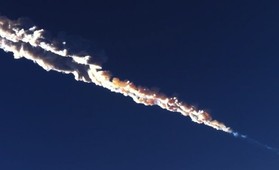
 Today a large object entered the Earth’s atmosphere above the Chelyabinsk region within Russia's Ural Mountains. The object left a streak across the sky as it burned through the atmosphere and eventually exploded. The force of the explosion, thousands of feet above the Earth's surface, was Some of the pieces landed on Earth and left small craters.
Did you know that some 30,000,000 pounds of space “stuff” come to Earth each year? A lot of that is in tiny objects that we don’t see or even know about. Every once in a while there is a larger object that comes down. Today’s object has been described as a “large” object and I even heard one report that the object was bus size. First question, was it an asteroid or a meteoroid? Well, the difference in space has to do with the size. Meteoroids are defined as space objects up to 1 meter in diameter and Asteroids are those that are larger than one meter in diameter and within the orbit of Jupiter (closer to the sun than Jupiter). So my guess is that it was an asteroid. There are tens of thousands of asteroids and uncountable meteoroids in the solar system. So why did they call it a meteor today if it was big enough to be an asteroid? Well, there are different names for the different locations that these live. When the objects are in space, they are either asteroids or meteoroids. But once they enter Earth’s atmosphere and start burning up (that’s what causes the smoke trail in the day or the burning line of light across the sky at night) then they become meteors. And once they land, they are generally referred to as meteorites. How fast are these objects going when they hit the Earth? Well, they are travelling through space at anywhere from 20,000 miles per hour to as much as 100,000 miles per hour. When they hit our atmosphere the speed of the object compresses the air in front of it until the air has been compressed to such an extent that the gases in our atmosphere are heated to over 3,000 degrees Fahrenheit. Many of you will have stuck a hand out a car window in the summer and felt the air going by at 60 miles per hour. Well, if you were to speed up really fast, then the air gets thicker where it hits your hand and before it has a chance to move around the sides. Now imagine going 20,000 miles an hour, that air gets compressed (squished) so much that it heats up to the thousands of degrees, which is hot enough to burn the material of most meteors. To learn more about all things space, try checking out some of these websites: Jordan Planetarium at UMaine in Orono http://www.galaxymaine.com/ Southworth Planetarium at USM in Portland http://www.usm.maine.edu/planet National Aeronautical and Space Administration (NASA) http://www.nasa.gov/
0 Comments
Leave a Reply. |
Categories
All
Archives
December 2015 September 2015 June 2015 May 2015 April 2015 March 2015 February 2015 January 2015 December 2014 October 2014 September 2014 August 2014 July 2014 June 2014 May 2014 April 2014 March 2014 February 2014 January 2014 December 2013 November 2013 October 2013 September 2013 August 2013 July 2013 June 2013 May 2013 April 2013 March 2013 February 2013 January 2013 December 2012 November 2012 October 2012 September 2012 August 2012 July 2012 June 2012 May 2012 April 2012 March 2012 February 2012 August 2011 July 2011 |
 RSS Feed